What Is LoRa for IoT? How It Works, LoRaWAN, and Best Use Cases
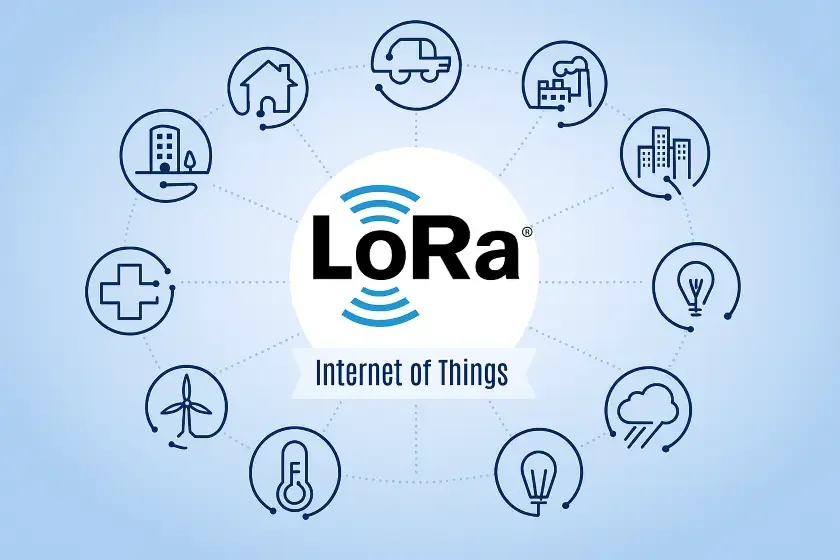
LoRa is a long-range, low-power wireless technology designed for Internet of Things systems that need to move small amounts of data across large areas without the energy overhead of Wi-Fi or traditional cellular links. In the official technical framing, LoRa is the radio modulation layer, while LoRaWAN is the LPWA networking protocol built on top of it. That distinction is the foundation of sensible architecture decisions, yet it is still one of the most common points of confusion in IoT content.
For engineers and product managers, LoRa matters because it sits in a very specific design space. It is not built for high throughput. It is built for coverage, battery life, and small telemetry messages. If the product requirement is “battery-powered sensor, infrequent uplinks, hard-to-reach location,” LoRa should usually be on the shortlist immediately.
What Is LoRa?
At its core, LoRa is the radio technology itself. Semtech defines it as a spread spectrum modulation technique derived from chirp spread spectrum, and presents it as a long-range, low-power platform for IoT. In practical terms, that means LoRa is the part of the stack responsible for getting bits from an end device to receiving infrastructure efficiently over distance.
That design focus explains why LoRa shows up so often in smart metering, environmental sensing, industrial telemetry, agriculture, and remote monitoring. Official LoRa materials emphasize exactly those kinds of battery-operated deployments, with vendor examples citing multi-mile coverage in urban and outdoor conditions and battery life measured in years rather than days.
How LoRa Works
Chirp Spread Spectrum and Long Range
LoRa achieves long-range performance through chirp spread spectrum. The important product implication is not just that the signal travels farther than many short-range protocols. It is that LoRa can trade raw throughput for better receiver sensitivity and more robust long-distance communication. That trade-off is what makes LoRa attractive for field sensors, meters, trackers, and status-monitoring devices.
Data Rate, Power, and Frequency Bands
The trade-off for that range is speed. Official LoRaWAN materials place data rates in the 0.3 kbps to 50 kbps range, which is ideal for soil-moisture readings, leak alerts, occupancy status, or meter values, but not for video, voice, or heavy data transport. A LoRa article that does not make this limitation explicit is technically incomplete.
Frequency planning also matters. LoRaWAN does not use one universal global band plan. The LoRa Alliance publishes regional parameters for different regulatory regions worldwide, which is why common deployment bands vary across markets such as Europe and North America. That affects certification, channel configuration, and sometimes SKU strategy for hardware teams.
LoRa vs LoRaWAN
The most useful plain-English explanation is this: LoRa is the radio; LoRaWAN is the networking standard that tells the radioed devices how to behave in a scalable system. LoRa can be used in proprietary or point-to-point implementations, but LoRaWAN is the open protocol layer built to support interoperability, network management, and larger deployments.
LoRaWAN Network Architecture
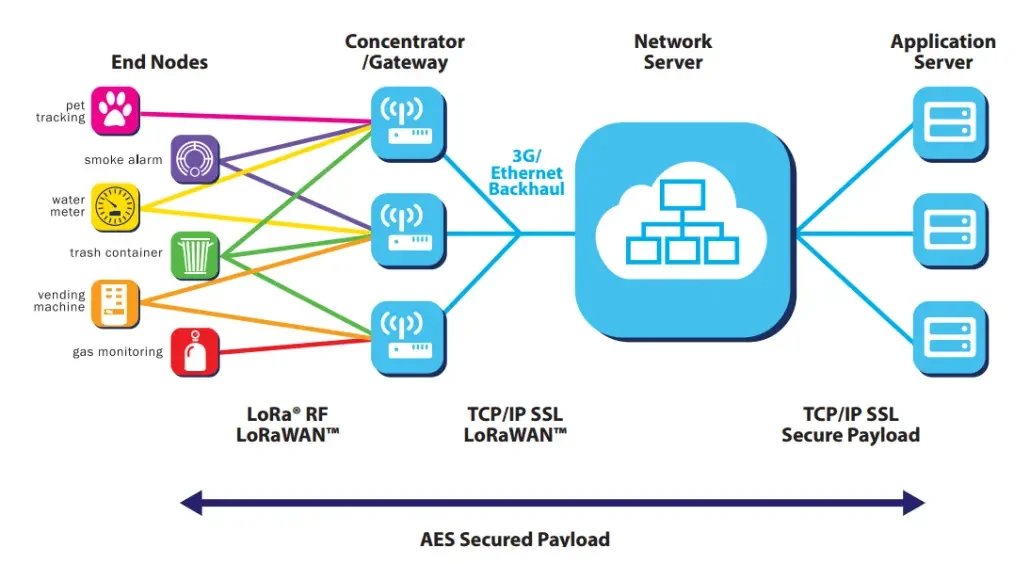
According to the LoRa Alliance, LoRaWAN networks use a star-of-stars topology. End devices send messages to one or more gateways, gateways forward those packets over standard IP connections, and the network server handles routing, adaptive data rate, and control logic. The alliance also specifies end-to-end security using AES-based cryptography with distinct network and application session keys.
LoRaWAN Device Classes
LoRaWAN also defines device classes, which is where power and latency trade-offs become operational. Class A is mandatory for all LoRaWAN end devices and is the lowest-power option because downlinks follow an uplink. Class B adds scheduled receive windows. Class C keeps the receiver open much more often, which reduces latency but increases power draw. For most battery-first products, Class A is the correct default.
LoRa vs Zigbee vs Cellular
The table below condenses official positioning from Semtech, the LoRa Alliance, Silicon Labs, and GSMA. The values are intentionally qualitative, because real-world performance depends on antenna design, topology, regulation, payload, and duty cycle.
| Technology | Range | Power | Data Rate | Typical Use Cases |
|---|---|---|---|---|
| LoRa | Very long, especially for sparse sensor links | Very low | Very low | Point-to-point or custom long-range sensor links, remote telemetry |
| LoRaWAN | Very long, networked through gateways | Very low, especially Class A | Very low | Smart metering, campus/building telemetry, agriculture, environmental sensing, asset tracking |
| Zigbee | Short to medium, typically home/building scale | Low | Low to moderate | Home automation, building controls, sensor/control mesh networks |
| Cellular LPWA | Wide-area, operator-managed coverage | Low to moderate | Low to moderate | Metering, logistics, remote monitoring where licensed-spectrum carrier coverage is preferred |
LoRa and LoRaWAN usually win when the payload is small, uplinks are infrequent, and the coverage footprint is larger than a building. Zigbee is often a better fit for dense local automation. Cellular LPWA becomes compelling when organizations want licensed-spectrum coverage and operator-managed infrastructure.
Best LoRa Use Cases
Official and ecosystem materials consistently point to use cases where devices are distributed, battery-operated, and mostly transmitting short bursts of data. The strongest examples include metering, smart buildings, smart cities, industrial monitoring, agriculture, and environmental sensing.
Good fits include:
Utility and smart metering
Soil, weather, and environmental sensors
Industrial status monitoring
Campus and building telemetry
Low-power asset tracking
Water, tank, or leak monitoring
These are strong fits because the traffic model is usually periodic, event-driven, or both. A sensor wakes, transmits a few bytes, and goes back to sleep. That is exactly the operating model LoRaWAN was designed to support.
When Should You Choose LoRa?
Choose LoRa when the design brief combines long range, low energy, and small payloads. If your product must survive on battery for years, operate across a farm, campus, plant, or rural site, and send status information rather than rich media, LoRa is usually a technically sound choice.
Do not choose LoRa simply because it is popular in IoT. If the application requires high throughput, frequent downlinks, or near-continuous connectivity, the protocol’s low data rate and power-first design become constraints. In those cases, Zigbee, Wi-Fi, or cellular LPWA may be better depending on the range, ownership, and infrastructure model.
Conclusion
LoRa is best understood as a purpose-built radio for long-range, low-power IoT, while LoRaWAN is the standards-based networking layer that makes that radio practical at scale. That framing answers the core search query quickly, preserves technical accuracy, and naturally supports the follow-up comparisons that search users actually want.
If you are evaluating connectivity for a new device, use the next architecture review to compare power budget, message size, coverage model, and infrastructure ownership before locking in the wireless stack. That one step will usually tell you whether LoRa belongs in the design—or whether another protocol is the better fit.